Contents
- Methodological preliminaries
- Generative grammars as theories of linguistic competence
- Toward a theory of performance
- The organization of a generative grammar
- Justification of grammars
- Formal and substantive universals
- Further remarks on descriptive and explanatory theories
- On evaluation procedures
- Linguistic theory and language learning
- Generative capacity and its linguistic relevance
- Categories and relations in syntactic theory
- The scope of the base
- Aspects of deep structure
- An illustrative fragment of the base component
- Types of base rules
- Deep structures and grammatical transformations
- Some residual problems
- The boundaries of syntax and semantics
- The structure of the lexicon
The goal of linguistic theory
A "grammar of a language" is "a description of the ideal speaker-hearer's intrinsic competence"
The structure of grammar
The syntactic component specifies an infinite set of abstract formal objects, each of which incorporates all information relevant to a single interpretation of a particular sentence. ... The phonological component of a grammar determines the phonetic form of a sentence generated by the syntactic rules. ... The semantic component determines the semantic interpretation of a sentence. That is, it relates a structure generated by the syntactic component to a certain semantic representation. (p. 16)
Both the phonological and semantic components are therefore purely interpretive. Each utilizes information provided by the syntactic component concerning formatives, their inherent properties, and their interrelations in a given sentence. Consequently, the syntactic component of a grammar must specify, for each sentence, a deep structure that determines its semantic interpretation and a surface structure that determines its phonetic interpretation. (p. 16)
"A grammar contains a syntactic component, a semantic component and a phonological component...The syntactic component consists of a base and a transformational component. The base, in turn, consists of a categorial subcomponent and a lexicon. The base generates deep structures. A deep structure enters the semantic component and receives a semantic interpretation; it is mapped by transformational rules into a surface structure, which is then given a phonetic interpretation by the rules of the phonological component. (p. 141)
Resolution of syntactic ambiguity
| flying planes is dangerous | ||
| flying planes can be dangerous | ⇉ | |
| flying planes are dangerous |
Das folgende ist übernommen aus https://en.wikipedia.org/wiki/Aspects_of_the_Theory_of_Syntax
Syntactic features
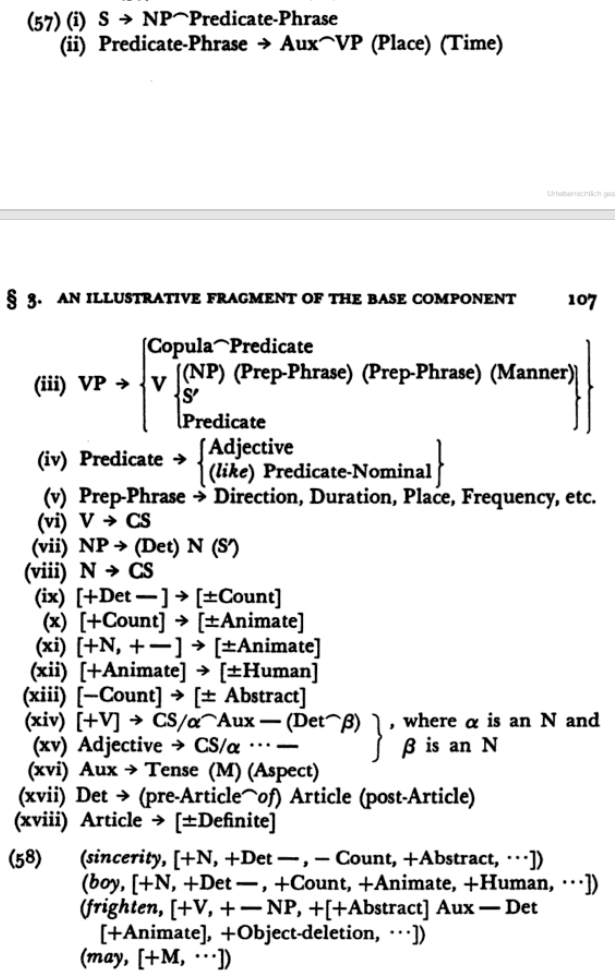
In Chapter 2 of Aspects, Chomsky discusses the problem of subcategorization of lexical categories and how this information should be captured in a generalized manner in the grammar. He deems that rewrite rules are not the appropriate device in this regard. As a solution, he borrows the idea of features from phonology. A lexical category such as noun, verb, etc. is represented by a symbol such as N, V. etc. A set of "subcategorization rules" then analyzes these symbols into "complex symbols", each complex symbol being a set of specified "syntactic features", grammatical properties with binary values.
Syntactic feature is one of the most important technical innovations of the Aspects model. Most contemporary grammatical theories have preserved it.